2026 is a milestone year for environmental artist Dan Monceaux as he exhibits his first retrospective solo exhibition in diverse media, spanning 17 years of casual art-making. Dan describes the works as “falling out” of him, adjacent to his work as a documentary filmmaker, environmentalist and public interest researcher. The exhibition is showing at Unit Three Collective in Lonsdale, South Australia and is open daily until August 31 as part of the South Australian Living Artists Festival (SALA).


CLICK TO DOWNLOAD CATALOG HERE
The earliest artwork in the exhibition is a single-shot video of Giant Australian cuttlefish, taken in waters near Whyalla in his first year of underwater videography, 2009. The work predates the commencement of his documentary film Cuttlefish Country (commenced 2011, unpublished as of 2026) which led the artist to develop a thorough and nuanced understanding of the South Australian marine environment, its ecology, existing and future environmental impacts, and the politics surrounding it. A single screen in the venue shows a selection of six of his video art pieces made under the Force of Nature banner, featuring familiar and exotic animals like Port Jackson sharks, Banjo sharks, fishes, crabs, colourful nudibranchs and even Blue-ringed octopuses mating.
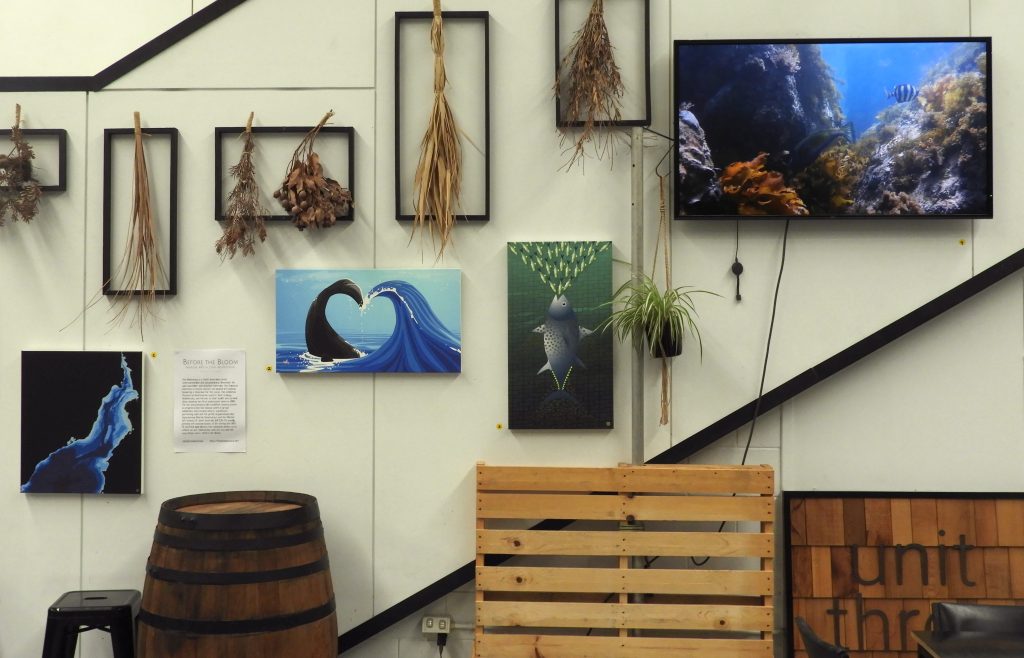
Monceaux’s works have shown previously in public space and gallery settings. His natural history video art pieces have been projected onto buildings in Port Adelaide and Port Elliot for special events, projected onto a fountain temporarily installed in the River Torrens and prominently placed on a large street-facing HD screen at the Adelaide Festival Centre. Group art exhibitions have shown his work at galleries around South Australia and in New South Wales, including Gallery Yampu in Port Adelaide, the Port Pirie Regional Art Gallery, Gallery 1855 in Tea Tree Gully, and the Arts Centre Port Noarlunga. Similarly his still photographic work has shown in group shows and at environmental education events, including the Totally Immersed series, in partnership with the not-for-profit organisation, Experiencing Marine Sanctuaries. Dan has also curated group exhibitions in partnership with EMS, the Marine Life Society of South Australia, and even hosted an underwater photography competition in Whyalla to encourage exploration and celebration of the marine environment he so loves. Breaking barriers between visual art and science, Dan curated the citizen science project It Came from the Harbour in 2019, which created photographic records of many marine species from West Lakes and Port Adelaide for the first time, including previously undocumented introduced species. It also led to the collection of specimens for the South Australian museum to further our scientific understanding of the South Australian marine environment.
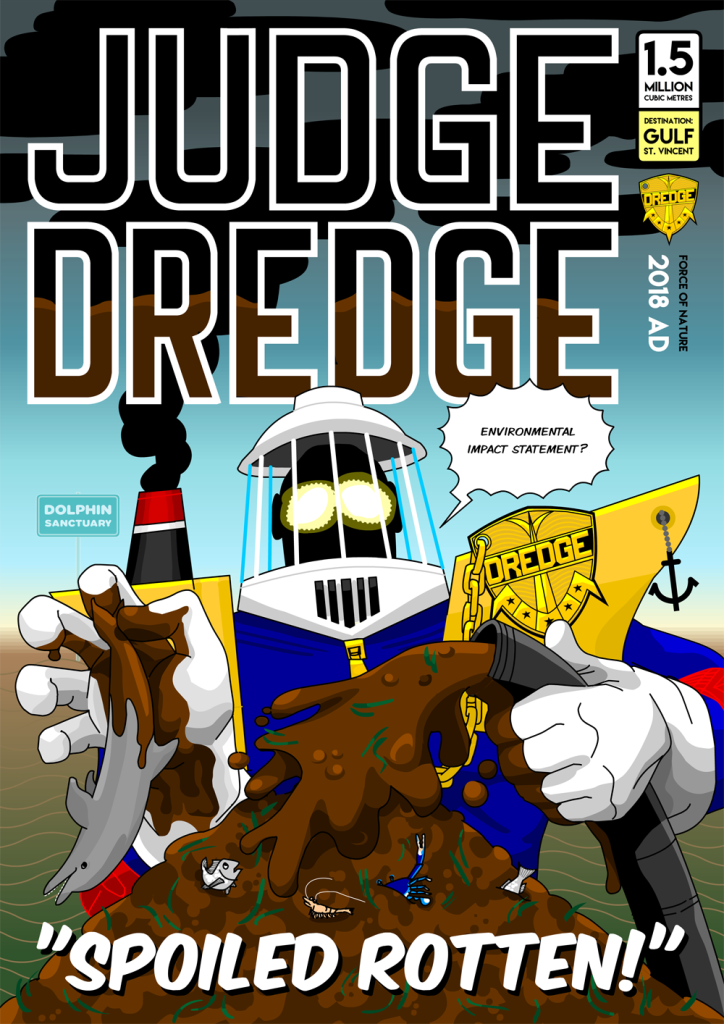
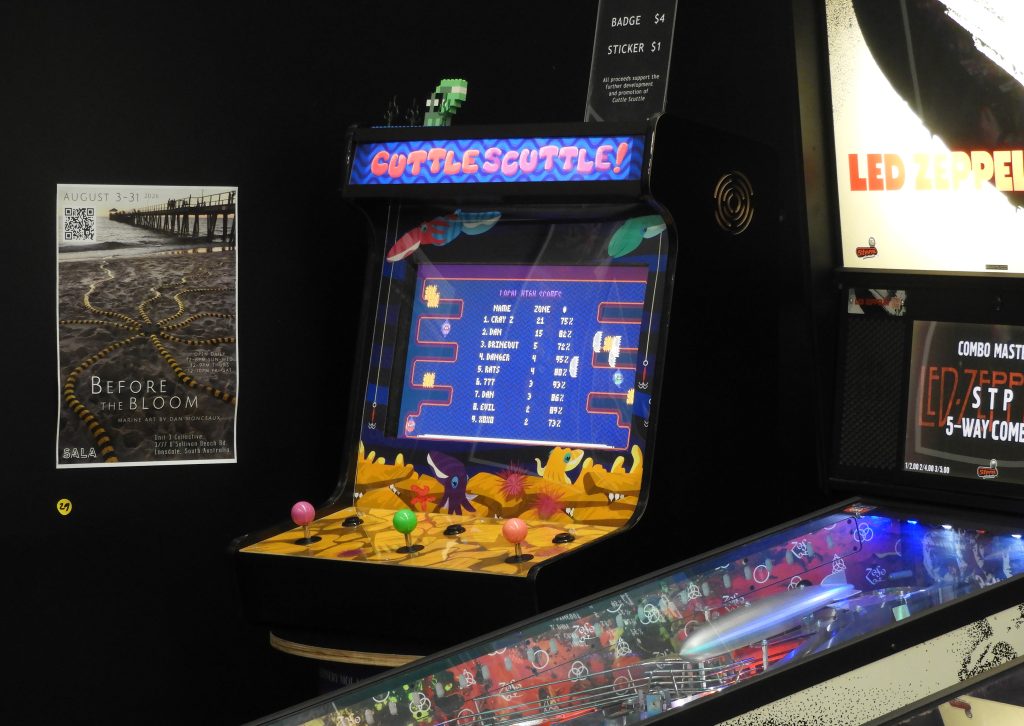
A self-taught amateur naturalist, Dan is also a university-trained illustrator. His illustrative approach is perhaps best seen in his mock comic book cover Judge Dredge – Spoiled Rotten (2018) which was made in response to the dredging of Outer Harbor, the approach to the busy seaport of Port Adelaide. The work asks for an environmental impact statement, which was never provided to the public, a development process that Monceaux has formally participated in many times while studying ports, desalination plants and fish farming while developing the documentary film, Cuttlefish Country. A child of the 1980s, his attraction to lo-fi digital artwork, pixel art in particular, led to the development of multiple pieces in the collection. His original computer game Cuttle Scuttle sits proudly in a custom-made retro arcade game cabinet for the first time here, wrapped with his illustrations. The game was developed between 2013 and 2018, and has been play-tested by thousands of children and children-at-heart in South Australia and Tasmania at events including like in the Indie Games Room at AVcon, at Science Alive and other environmental events. The Beta version of the game is playable cooperatively by three players, who play as female cuttlefish and progress through the game by discovering, observing and negotiating marine ecology and the environmental impacts of human activities.
Direct criticism and cautionary notes abound in Dan Monceaux’s work, which stems directly from his inquiries as a documentary filmmaker and public interest researcher. Works draw attention not only to overlooked and poorly understood marine species and habitats, but also to imminent threats to their survival. The most direct example of this is the animated LED sign piece Sign of the Times (2014, revised 2017) which makes simplified yet powerful statements about specific events and pressures relates to marine conservation in South Australia. The LED sign’s animation also repurposes sprites originally made for the game, Cuttle Scuttle. More recently moved by the catastrophic loss of South Australian marine life during the globally significant harmful algal blooms of 2025-26, Dan designed a short animated visual poem which is displayed on an LED backpack. The piece is called Toxic Relationship (2025), and it first showed at the art exhibition Algal Room, curated by Toxic Surf and shown at Good Bank Gallery in McLaren Vale, South Australia. With repeated use of the words “burn”, “dump” and “take” arranged with evocative movement and colour, Dan reduces the causes of the bloom down to three harmful, sustained activities, all of which humanity is directly responsible for.
Dan’s playful response to art-making can be seen not only in the game Cuttle Scuttle and his LED animations, but also in his surprising collage and sculptural work. His work Widebodied pipefish (2018) places cardboard hand drawn and machine-cut pipefish among tapeweed (seagrass) made from actual adhesive washi tape, set against cut paper backgrounds. His piece Money Trap #2 turns an actual crab net into a miniature seacage fish farm, suspending it from above and populating it with fish cut by hand from a corroding sheet of galvanised iron fencing. The rusted condition of the fishes is intended to reflect the inevitable animal health issues that stem from intensive livestock farming. Each fish is suspended from the net itself by line and tackle. His material choices are a reference to the commercial fishing origins of this industrial activity.

Dan’s three digitally illustrated works on canvas were drawn using a computer, then printed as one-off pieces on canvas. Hard lines and gentle curves is an accurate visualisation of the bathymetry (bottom depth) of Spencer Gulf, and was painstakingly assembled from paper bathymetric charts, photographed, combined, traced and coloured. This work has also appeared on a striking T-shirt design (not shown), a reminder of Dan’s unconfined attitude towards art, the form it takes and where it is seen. The other two works on canvas For the love of the ocean (2015) and Money Fish (2018) show his playful cartooning style and symbolic approach respectively. Money Fish is a visual representation of tuna ranching (seacage farming) in which sexually-immature Southern bluefin tuna are caught in the wild, held captive and fed tens of thousands of tonnes of locally caught sardines annually. This activity produces the largest industrial nutrient pollution source in the state and profits of a handful of concentrated financial interests. On close inspection, the pattern of the net reveals that it is actually a mesh of dollar signs- the sole motivation for this environmentally destructive activity.
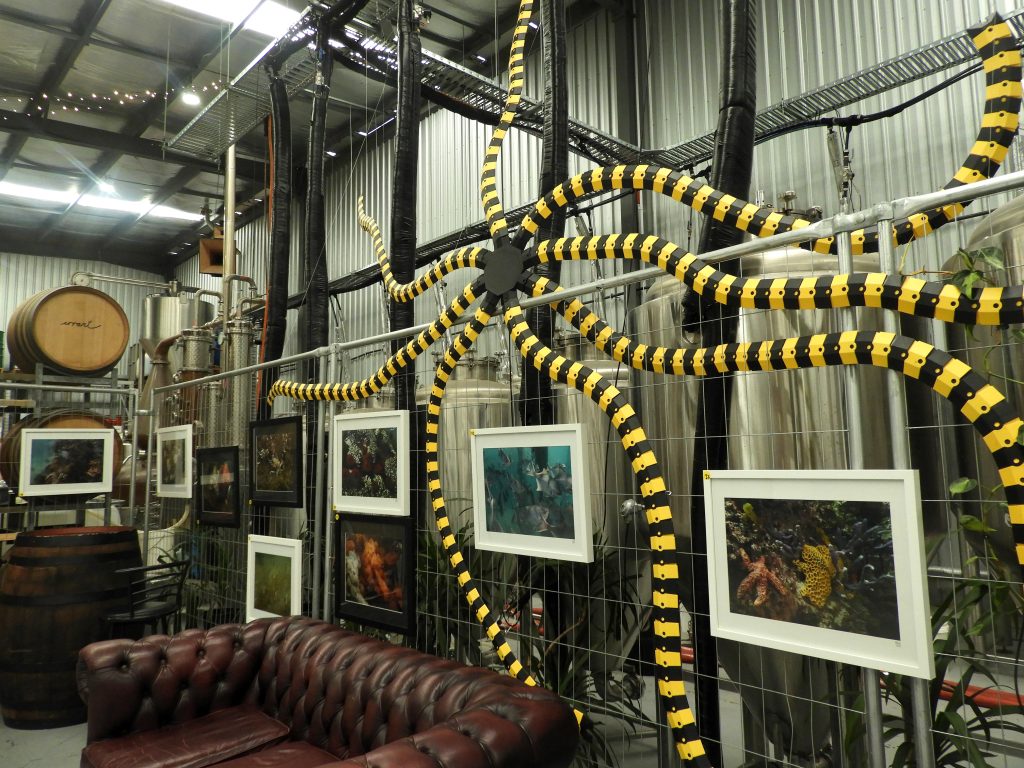
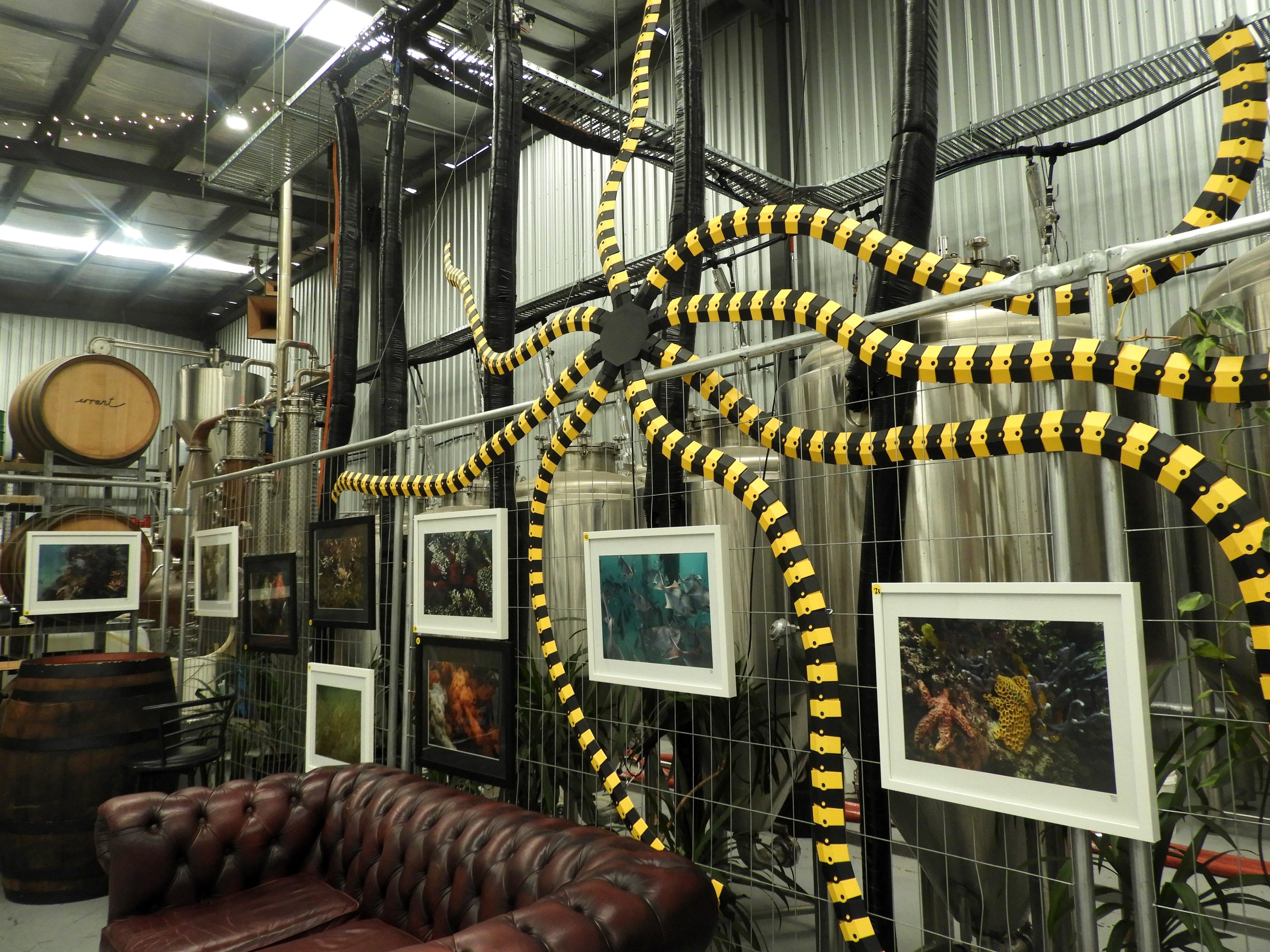
Monceaux’s most recent signature piece, which appears on the exhibition poster and hangs ominously in the space suspended by fishing line from a gantry is called “Is it safe?” Like Toxic Relationship, it was made in direct response to the 2025-26 harmful algal bloom. Intended to represent the bloom itself in the form of a monstrous, over-sized brittle star, a faceless eating-machine, this instance sees the work hung vertically for the first time, with its arms reaching around displayed photographic work. The piece has shown indoors at The Power of Activism event and The Bloom another group exhibition curated by Toxic Surf, held at the Arts Centre Port Noarlunga. A 40 metre wide version was temporarily installed at Henley Beach and Port Elliot, each for one day only, with the work emerging from the surf zone. A past resident of Port Noarlunga, Monceaux’s last significant exhibition was held there in 2020 as a two-person show with his then wife Emma Monceaux (now Emma Sterling) under the title River to Reef, which set out to showcase the biodiversity of the Onkaparinga River inlet and Port Noarlunga reef. Like its precursor It Came from the Harbour , the preparatory photographic work also helped establish a more complete picture of the area’s biodiversity through hundreds of observations contributed to the citizen science platform, iNaturalist.
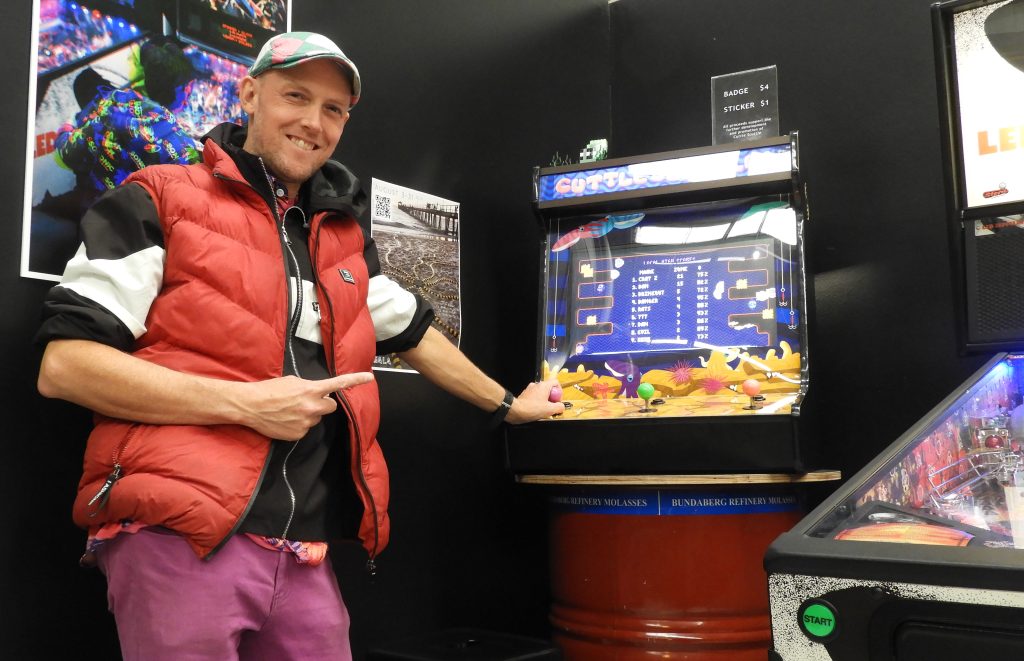
Having such an informal approach to art-making has ben liberating for Monceaux, who can’t predict what shape his next artwork will take or what it might be made in response to. Despite unexpected delays in their progress, he intends to complete both of his core long term projects as soon as possible. The documentary film Cuttlefish Country is more relevant than ever with the cuttlefish breeding population near Whyalla falling to the lowest ever recorded in the wake of the harmful algal bloom. Along with his game Cuttle Scuttle these pending works have the potential to reach and inform adults and children respectively around the world and build global ocean literacy. Dan’s creative practise is driven by a sense of social responsibility, loaded with knowledge and insight to share and a personal commitment to helping humans outgrow bad habits and develop a more harmonious relationship with the ocean.
Before the Bloom – Marine Art by Dan Monceaux
August 3-31 2026
Unit 3 Collective
3/77 O’Sullivan Beach Rd
Lonsdale, South Australia
OPEN HOURS
12noon – 6pm Sunday-Wednesday
12noon – 9pm Thursday
12noon – 10pm Saturday-Sunday
Leave a Reply